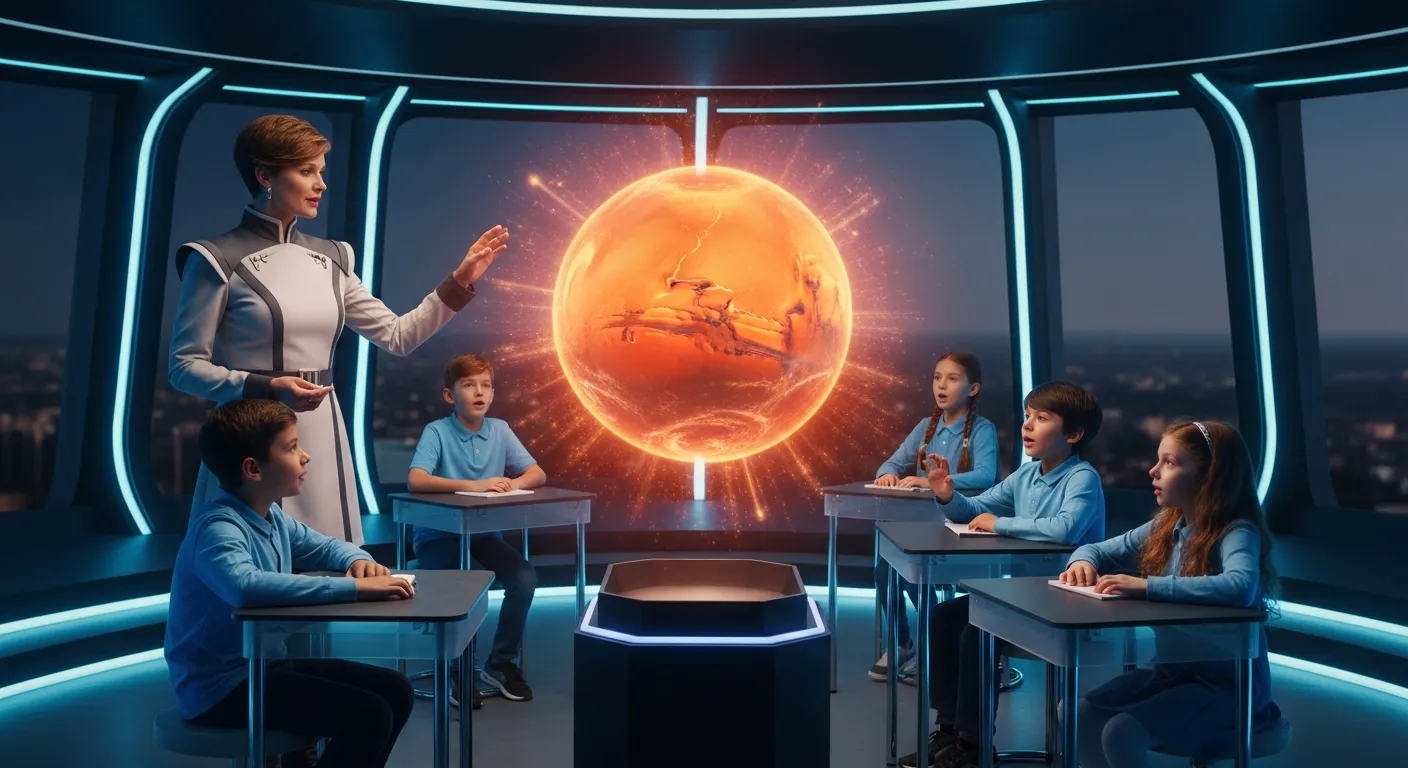
Mars Curricula
Standards-aligned lesson plans bringing Mars science into K-12 classrooms. Developed by Director of Education Nicole Willett.
Elementary (K-6)
Our Solar System Neighbor
Kindergarten students discover Mars as a planet in our solar system through observation, comparison, and creative expression.
Mars Weather and Seasons
First grade students compare weather and seasons on Earth and Mars, learning that Mars has familiar patterns with extreme differences.
Rocks and Minerals on Mars
Second grade students explore the geology of Mars by comparing Earth rocks and minerals with those found on the Martian surface.
The Search for Water on Mars
Third grade students investigate evidence for past and present water on Mars through hands-on erosion experiments and analysis of NASA imagery.
The Atmosphere of Mars
Fourth grade students compare the atmospheres of Earth and Mars, investigating air composition and why humans will need life support systems on Mars.
Is There Life on Mars?
Fifth grade students explore the scientific search for life on Mars, learning about extremophiles on Earth and what biosignatures scientists look for on the Red Planet.
Designing a Mars Settlement
Sixth grade students apply their knowledge of Mars science to design a sustainable human settlement, addressing shelter, food, water, energy, and life support challenges.
Middle School (7-8)
Mars Geology and Comparative Planetary Science
Students conduct a comparative study of geological processes on Earth and Mars, analyzing volcanic features, impact craters, and surface evolution using NASA data.
Mars Climate History and Habitability
Students investigate the climate history of Mars, modeling how the planet transitioned from a warm, wet world to the cold desert we see today, and evaluate its potential for future human habitability.
High School (9-12)
Orbital Mechanics and the Journey to Mars
Students apply physics concepts to calculate Hohmann transfer orbits, launch windows, and delta-v requirements for an Earth-to-Mars mission.
Mars Atmospheric Chemistry and In-Situ Resource Utilization
Students analyze the chemical composition of Mars's atmosphere and design processes for producing oxygen, water, and rocket fuel from Martian resources using ISRU principles.
Astrobiology and the Search for Life on Mars
Students apply biology and chemistry concepts to evaluate the evidence for past or present life on Mars, designing detection experiments and analyzing real mission data.
Mars Settlement Engineering Design Challenge
Students apply multidisciplinary STEM knowledge to design a comprehensive Mars surface settlement, integrating habitat engineering, life support, power systems, and resource utilization into a complete mission architecture.